
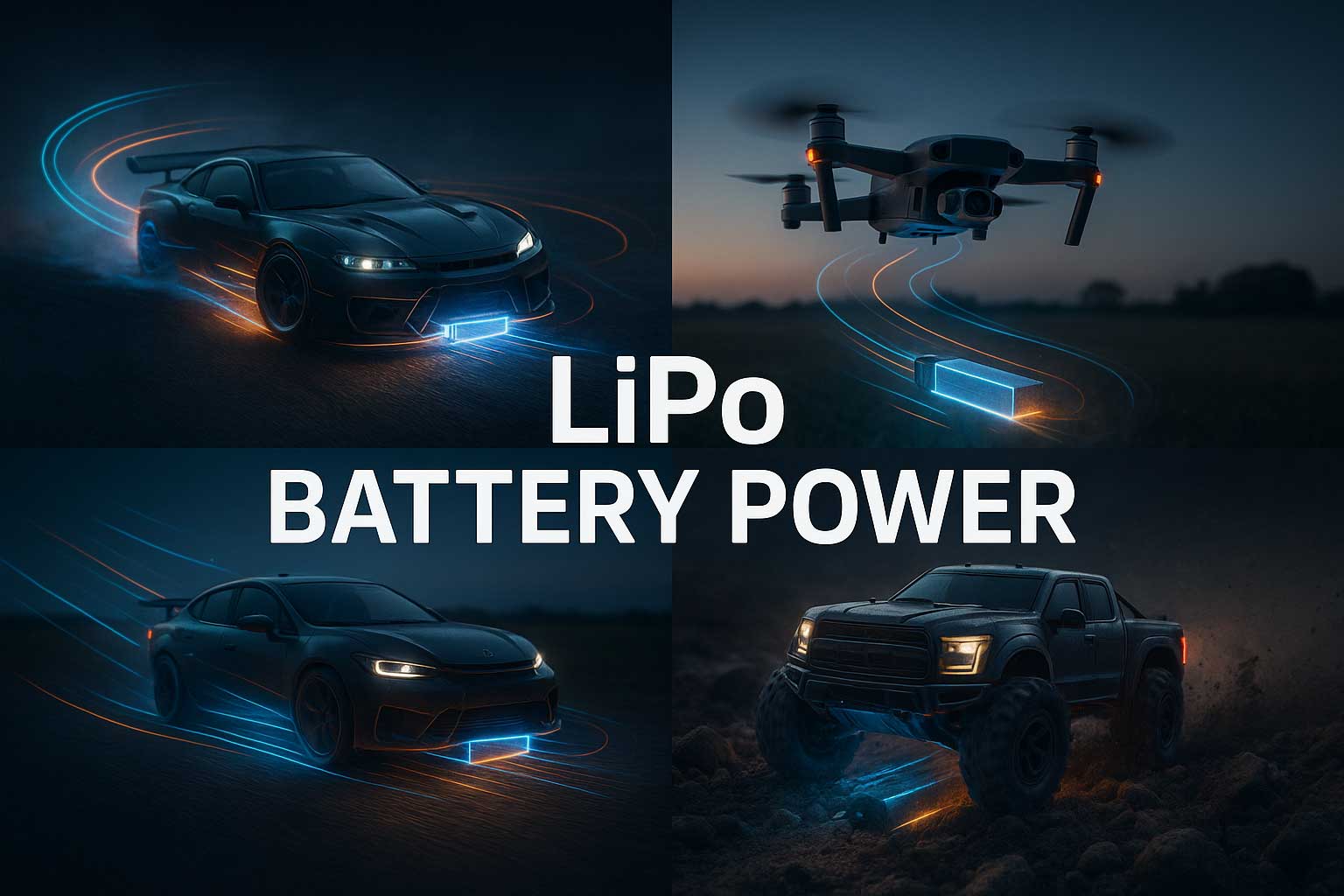
When it comes to powering your RC car, truck, or drone, one battery chemistry dominates the field — the LiPo battery (Lithium Polymer). Known for their lightweight design, high energy density, and strong discharge performance, LiPo batteries have become the standard choice for hobbyists and professionals alike.
What Makes LiPo Batteries Special?
Unlike older battery types such as NiMH or NiCd, LiPo batteries can deliver high current bursts without significant voltage drop. This makes them ideal for RC racing cars and high-speed drones that demand quick acceleration and consistent power. LiPo packs are also available in a wide range of voltages and capacities — typically measured in “cells” (like 2S, 3S, 4S) and “mAh” (milliampere-hour).

- High Power-to-Weight Ratio: LiPo cells store more energy in a smaller and lighter package, which means better performance and flight time.
- High Discharge Rate: Perfect for RC trucks that need instant torque or drones performing fast maneuvers.
- Customizable Shapes: Soft-pack designs allow flexible dimensions to fit inside various RC models.
Choosing the Right LiPo Battery for Your RC Car or Drone
When selecting a LiPo battery, you should focus on three main specifications: voltage (V), capacity (mAh), and discharge rate (C). Here’s a quick guide:
- Voltage (V): Determines how fast the motor spins. For example, most RC cars use 7.4V (2S) or 11.1V (3S) batteries, while larger drones may require 14.8V (4S) or higher.
- Capacity (mAh): A higher capacity means longer runtime, but also more weight. For example, 5000mAh is common for RC trucks and drones under 1kg.
- C-Rating: Indicates how fast the battery can safely discharge. A 30C battery can deliver 30 times its capacity in current. For example, a 5000mAh 30C pack can output 150A (5 x 30 = 150).
Fast Charge & High Discharge Technology Explained

Modern LiPo batteries have evolved far beyond early designs. Today’s high-performance packs for RC cars, trucks, and drones rely on a combination of advanced materials and smart electronic control systems to achieve both fast charging and high discharge without sacrificing safety.
1. Advanced Electrolyte Formulations
The electrolyte — the “blood” of a LiPo cell — determines how efficiently ions move between the anode and cathode. Modern high-rate LiPo batteries use optimized polymer electrolytes with additives like LiPF₆ and organic carbonates to lower internal resistance. This enables faster ion transfer, which supports quick charging (up to 5C in some premium models) and stable high-current discharge without excessive heat buildup.
2. High-Strength Electrode Materials
The cathode (positive electrode) often uses LiCoO₂ or NMC (Nickel Manganese Cobalt) materials, while the anode is composed of high-purity graphite or silicon-doped carbon. These materials have superior conductivity and structural stability, allowing higher energy throughput and preventing degradation during aggressive use in racing RC vehicles or aerobatic drones.
3. Reinforced Separator Design
The separator — a thin polymer film between electrodes — is now engineered with nano-coatings that enhance thermal resistance and ion flow. This helps prevent short circuits or thermal runaway during high C-rate discharges or when charging at elevated currents.
4. Smart Battery Management System (BMS)

Many LiPo packs now integrate a miniaturized BMS (Battery Management System) or external protection board. These systems monitor voltage, temperature, and current in real-time. If the pack begins to overheat or a cell imbalance occurs, the BMS can automatically limit current or disconnect charging. In racing drones, this feature extends lifespan without limiting power output.
5. Intelligent Charging Algorithms
Modern chargers use dynamic algorithms that combine CC/CV (Constant Current / Constant Voltage) methods with real-time thermal feedback. Some even use AI-assisted charging curves to adjust current based on the battery’s condition and ambient temperature. This minimizes stress on the cells and allows safe fast charging within 20–30 minutes — a major improvement from the older 1-hour charge cycles.
LiPo Battery Care and Safety Tips

LiPo batteries are powerful but sensitive. Improper use or charging can lead to swelling, fire, or permanent damage. Follow these essential tips to keep your batteries safe and long-lasting:
- Always use a LiPo balance charger and never overcharge above 4.2V per cell.
- Do not discharge below 3.0V per cell — this can cause irreversible damage.
- Store batteries at storage voltage (around 3.8V per cell) if not used for weeks.
- Never puncture or crush LiPo packs — damaged cells can ignite easily.
- Use a fireproof LiPo bag during charging and transportation.
Applications: From RC Cars to Drones

LiPo batteries power everything from small RC drift cars to high-performance racing drones. In RC cars and trucks, they deliver explosive acceleration and consistent runtime. For drones, they provide the high power-to-weight ratio needed for longer flight times and stable flight control.
With ongoing improvements in energy density and safety technology, modern LiPo batteries now last longer, charge faster, and offer built-in protection circuits — making them more user-friendly than ever.
Quick Comparison Chart
| Application | Typical Voltage | Capacity Range | Runtime (Approx.) |
|---|---|---|---|
| RC Car (1/10 scale) | 7.4V (2S) | 4000–6000mAh | 20–30 mins |
| RC Truck (1/8 scale) | 11.1V (3S) | 5000–8000mAh | 25–40 mins |
| Drone (Racing/Freestyle) | 14.8V (4S) | 1300–1800mAh | 5–8 mins |
| Photography Drone | 22.2V (6S) | 4000–6000mAh | 20–35 mins |
Final Thoughts
Whether you’re building a racing RC truck, upgrading your drone, or tuning your hobby car, choosing the right LiPo battery makes all the difference. Balance voltage, capacity, and C-rate for your setup — and always prioritize safety during use and charging. Modern LiPo batteries, with improved electrolytes, reinforced materials, and intelligent management systems, now deliver unmatched fast-charging and high-discharge performance that continues to push the boundaries of RC and drone technology.
Frequently Asked Questions (FAQ)
1. Can I use any LiPo battery in my RC car or drone?
No. Always check your device’s voltage and current requirements. Using an incompatible battery can damage your electronics.
2. How long do LiPo batteries last?
Typically 150–300 charge cycles, depending on how carefully they are used, charged, and stored.
3. Why does my LiPo battery swell?
Swelling is usually caused by overcharging, deep discharging, or overheating. Dispose of swollen batteries safely.
4. What is the best C-rating for RC vehicles?
A 30C–60C range is ideal for most RC cars and drones. High-speed racers may prefer 75C or above for extra punch.
5. Can I charge a LiPo battery with a normal charger?
No. You must use a LiPo-compatible balance charger to avoid fire hazards and ensure safe charging.